The Model Knew First: How CEV 6.31 Identified Japan's Biggest Hidden Monsters Before the Market Did
Auditing 2,734 companies to identify the 800% returns the market ignored.

1. What is CEV 6.31?
Corporate Energy Vector (CEV) is a deterministic arbitrage model designed to strip away market “Poems” (expectations) and reveal “Muscles” (real productivity).
At its core, CEV measures the tension between two vectors:
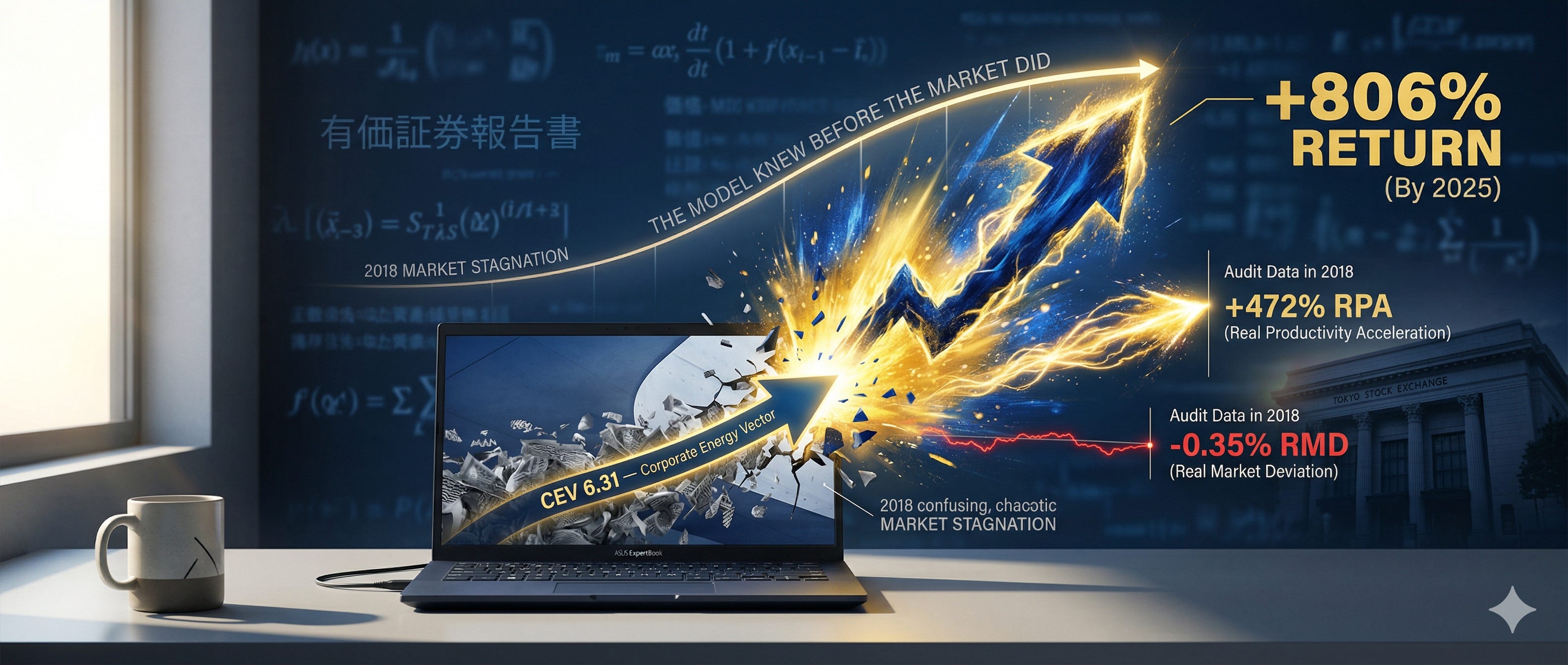
RPA (Real Productivity Acceleration): The “Muscle.” It measures the acceleration of operating income per employee, strictly adjusted for inflation (GDP Deflator). It detects when a company’s internal efficiency is exploding.
RMD (Real Market Deviation): The “Poem.” It measures a stock’s Alpha (TSR vs. Benchmark) adjusted for currency fluctuations ($\Delta FX$). It represents how much the market is currently over-praising or ignoring the company.
The Logic: Find the “Hidden Monsters” where RPA is accelerating, but RMD remains stagnant or negative.
2. The Audit: 2,734 Companies, 0 Humans
This past Sunday, I conducted a full-scale audit of the Japanese market.
Universe: 2,734 listed companies.
Data Points: 13,287 fiscal year entries (2015–2020) pulled directly from XBRL (EDINET).
Execution: 100% autonomous AI Agent (The Builder).
No manual spreadsheets. No human bias. No “office politics.” Just raw computational power identifying mathematical contradictions in market pricing.
3. The Hidden Monsters: Top 5 (2018 Audit)
Our model identified five companies where the gap between real power and market recognition reached a breaking point. These were the top “Arbitrage Targets” as of 2018:
Abalance (2018): Arb Score 4.06
LIFULL (2018): Arb Score 3.92
Uchiyama Holdings (2017): Arb Score 3.81
Nichiryoku (2019): Arb Score 3.79
Wealth Management (2018): Arb Score 3.63
4. Backtest: The Prophet of Productivity
Does the model work? The results of the 2018 “Monsters” are staggering:
Mizuno (2018): While the market dismissed it as a “boring” mature brand, CEV detected a +472% RPA. The market recognition was at -0.35%. Result? A +806% return by 2025.
Abalance (2018): Ranked as the #1 monster with a massive productivity surge. Result? A legendary +11,250% return at its subsequent peak.
The model knew the trajectory years before the institutional analysts issued their first “Buy” ratings.
5. What CEV Missed: The Hard Truth
Integrity is part of the ARAYASHIKI philosophy. Quantitative models reflect reality, and reality can be deceptive.
Accounting Illusions: Abalance’s high RPA was partly a result of aggressive revenue recognition that later faced auditor scrutiny.
Project Lumps: Nichiryoku’s spike was due to one-time project completions, not a sustainable change in business structure.
Goodwill Bombs: LIFULL’s productivity was real, but a massive overseas “Goodwill” impairment risk (Trovit) acted as a time bomb that suppressed the stock price longer than predicted.
6. What’s Next: CEV 7.0
We are already evolving. To solve the “illusion” problem, we are implementing the Quality Multiplier in CEV 7.0.
Accrual Ratio: Verifying if profits are backed by hard cash, not just ledger entries.
Stability Score: Distinguishing between long-term “Muscles” and one-time “Spikes.”
Goodwill Index: Automatically discounting companies with high impairment risks.
The era of the “Human Analyst” is over. The era of Sovereign Intelligence has begun.